📄 Digital book in PDF · read it on your phone or print it
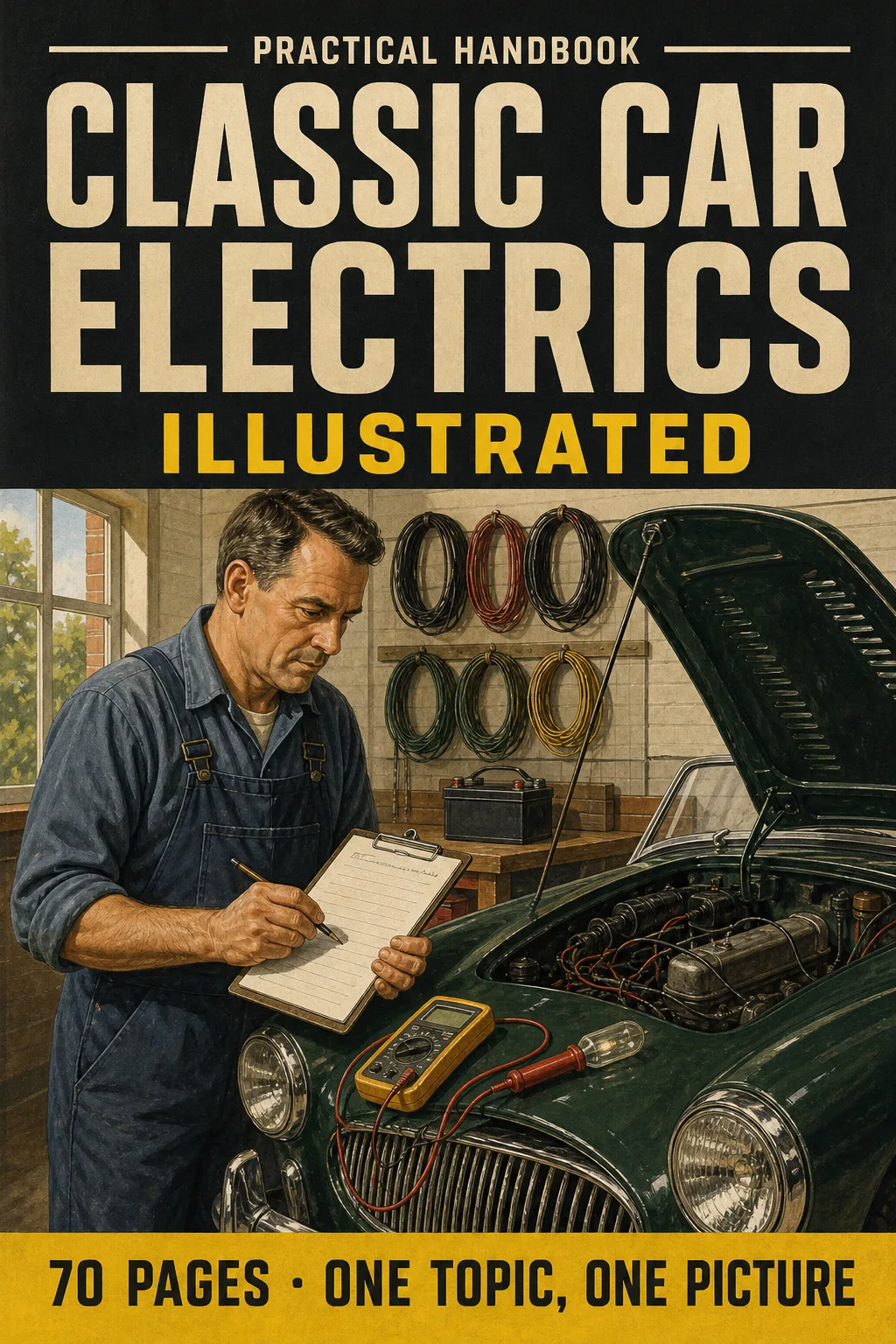
Positive earth, the British colour code, the multimeter, battery and dynamo, the control box, coil and points, headlamps and the relay upgrade. Every topic has its own page: first the drawing, then what you need to remember. 70 illustrated pages.
🔒 Secure checkout · PDF by email · 30-day guarantee
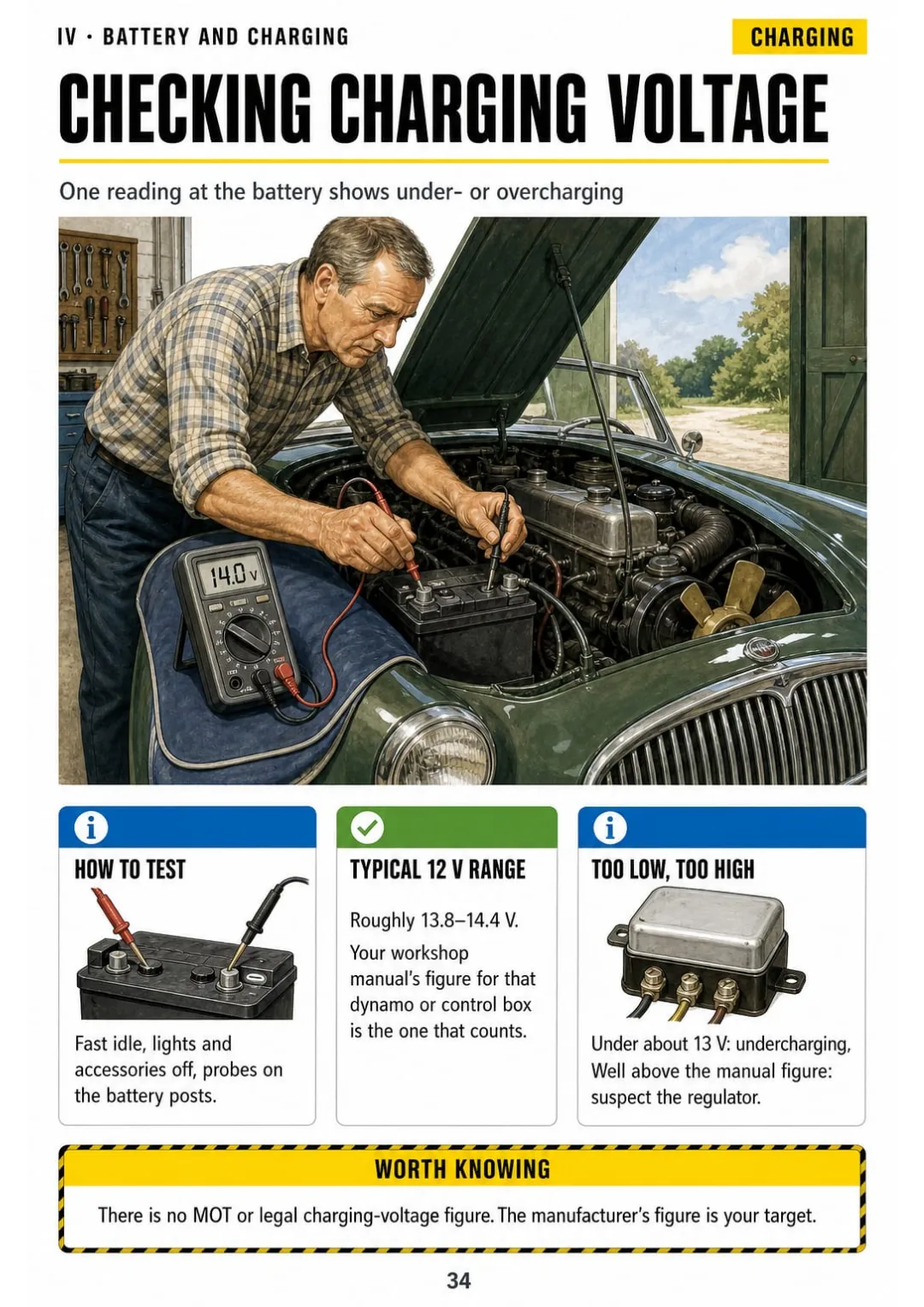
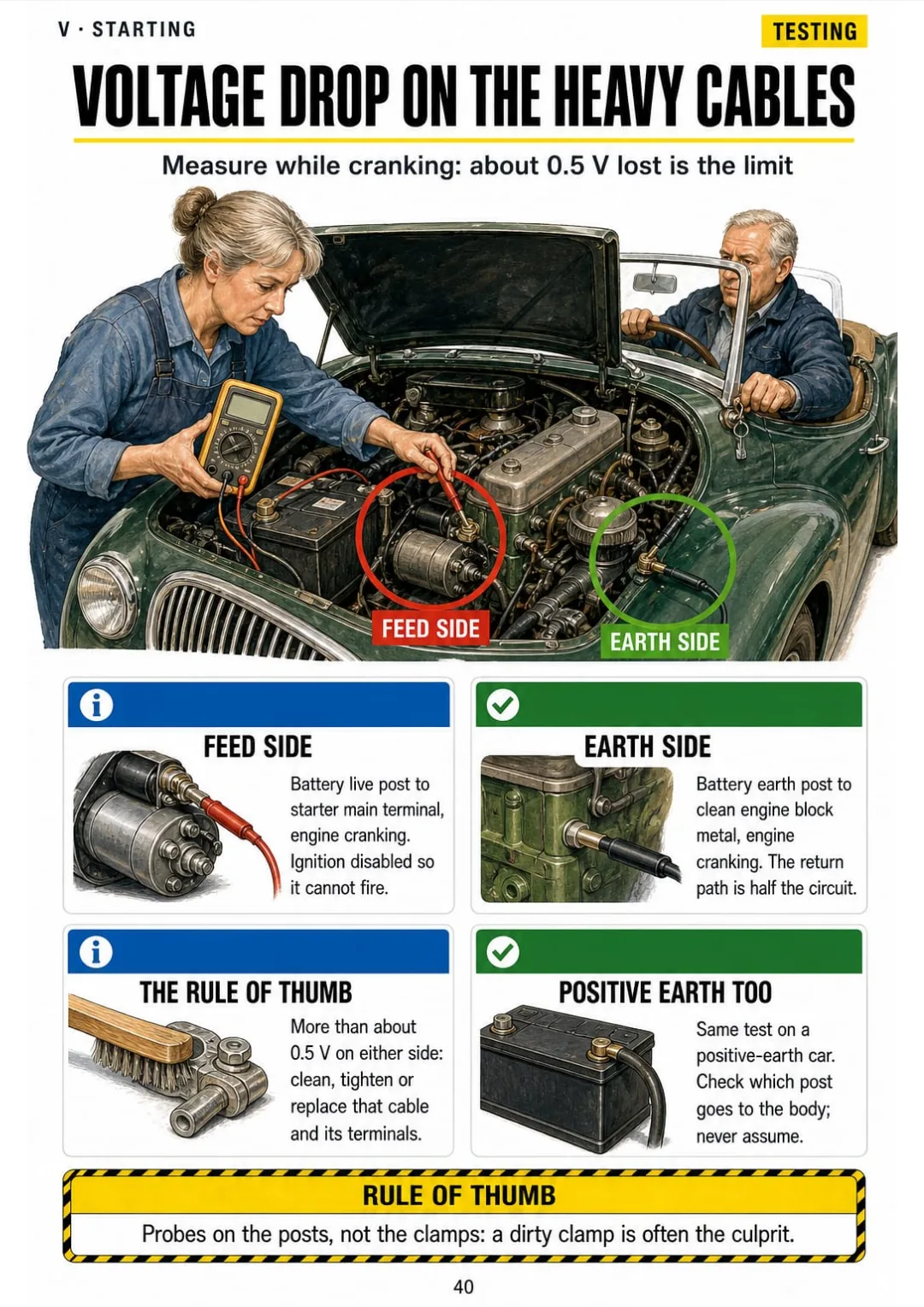
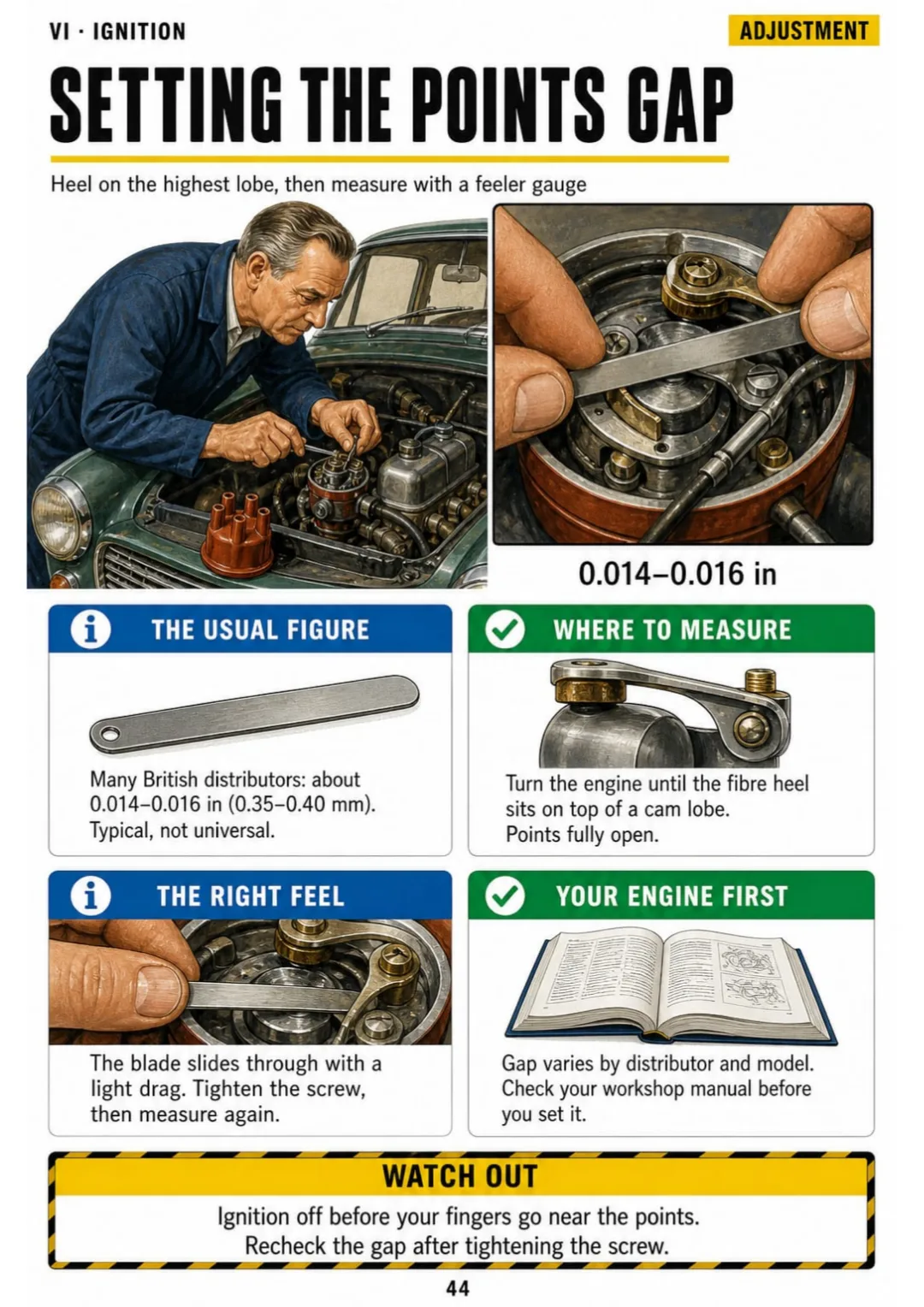
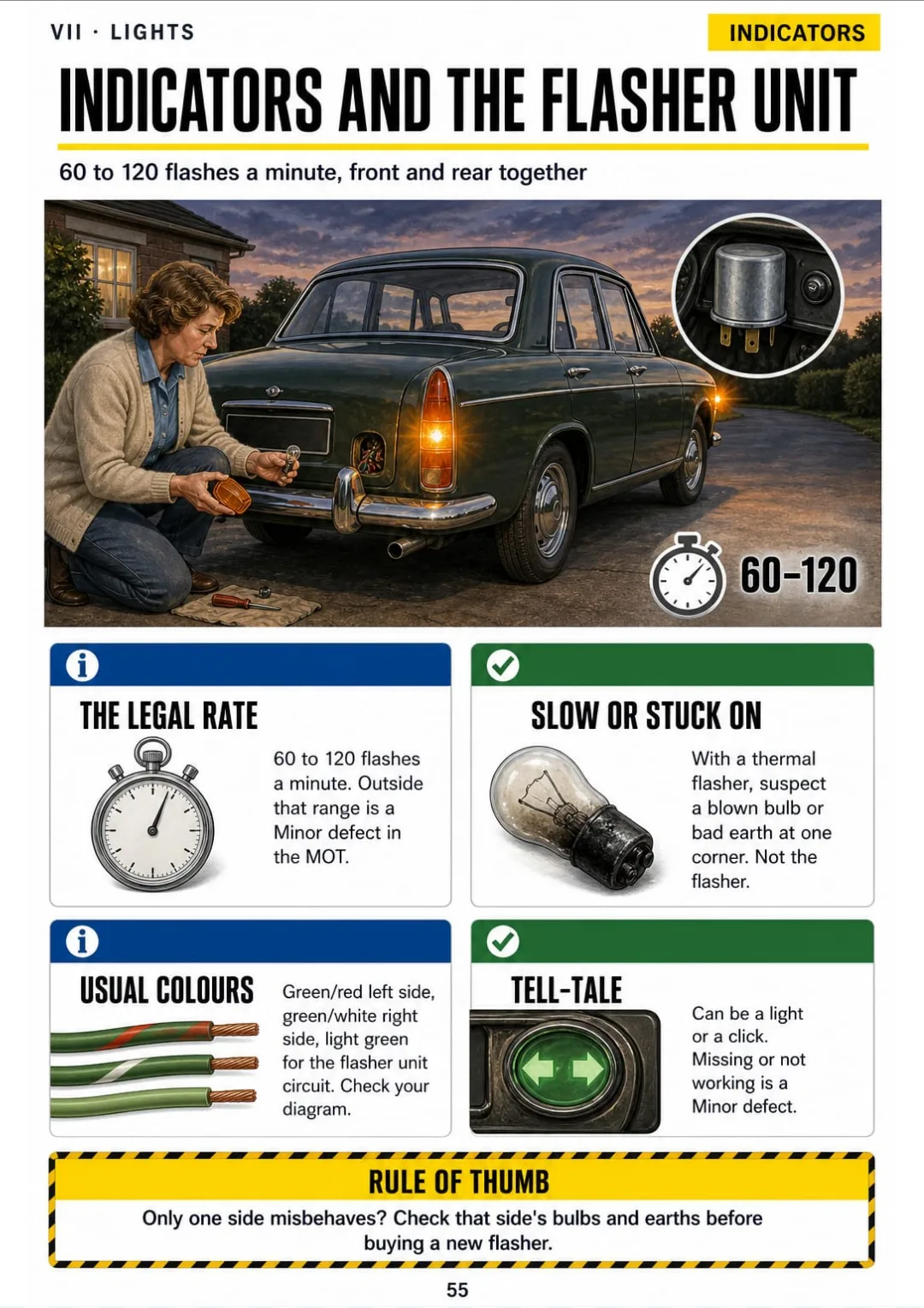
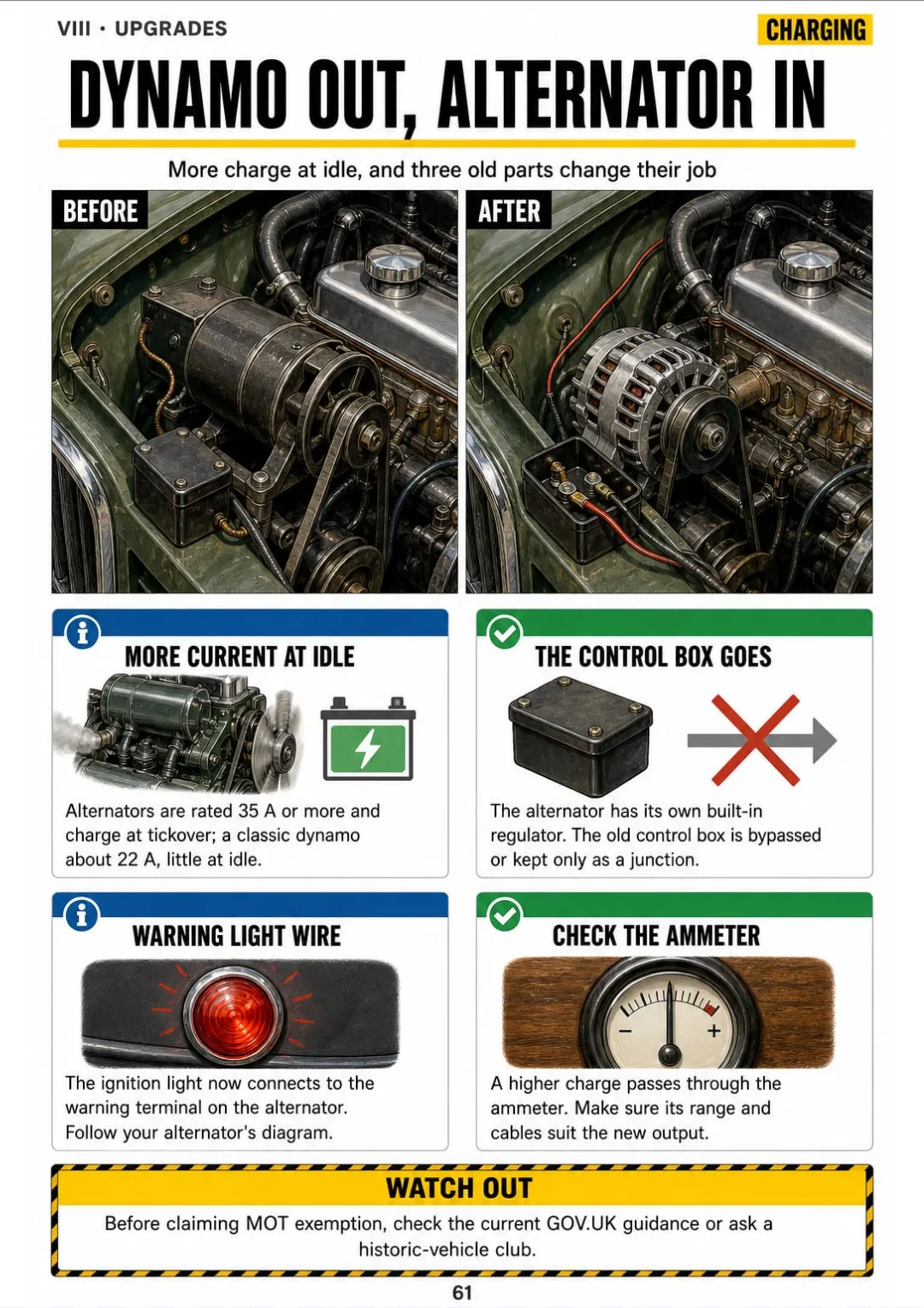
Every page has one large drawing and a box with the readings, colours and steps you need to know:


Swipe to see more →
These are real pages from the book. The table of contents is the full one: 9 parts and 66 topics.
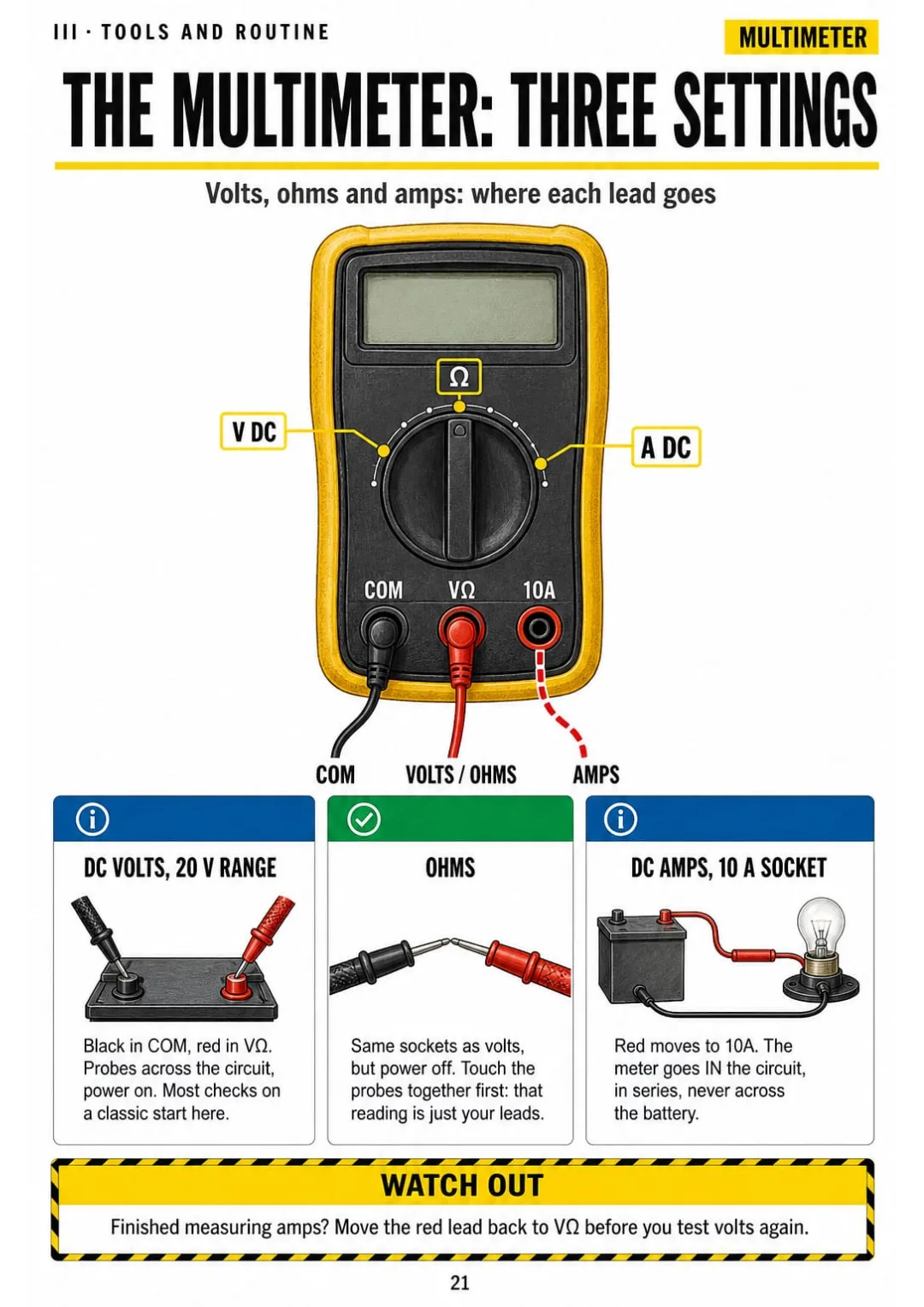
You're in the garage, the battery's flat again, and the multimeter in your hand has a dial with twenty positions. You need one reading. You don't know which one.
The manual covers it in three paragraphs on ranges, sockets and polarity. It never shows you where the dial goes or where the red lead plugs in. So you guess, and hope you don't blow the meter's fuse.

In the book, that same meter is one page. Three settings circled: volts in the VΩ socket with the power on, ohms with the power off, amps through the 10 A socket, in series. The probes are drawn where they go.
Every other job works the same way. Battery state, the dynamo's control box, the points gap, the headlamp relay and the parasitic draw test: each one has its own page.
You look at the page, set the dial and read the number. You understand what it's telling you and carry on without going back to the manual.

How a circuit works, reading the wiring, your tools and the routine, battery and charging, starting, ignition, lights and accessories, upgrades and rewiring, and a practical review: 70 pages, all illustrated
Think of it this way:
It's Saturday morning, the engine's running and the charge light on the dash won't go out. You want to know if it's the belt, the dynamo or the control box before you start undoing things.
You open the book at that page. The dynamo, the control box and the warning lamp are drawn as one circuit, with the wire that lights the lamp and the reason it goes off.

The same goes for the points gap, dim headlamps, the parasitic draw test, the engine-to-body earth strap and positive earth: each one on its own page, drawn the same way.
Classic Car Electrics Illustrated is 9 parts and 66 topics, all drawn, with a practical review at the end: a symptom-to-circuit finder, readings worth remembering and a before-the-drive checklist.
What you see drawn, you don't have to memorize.
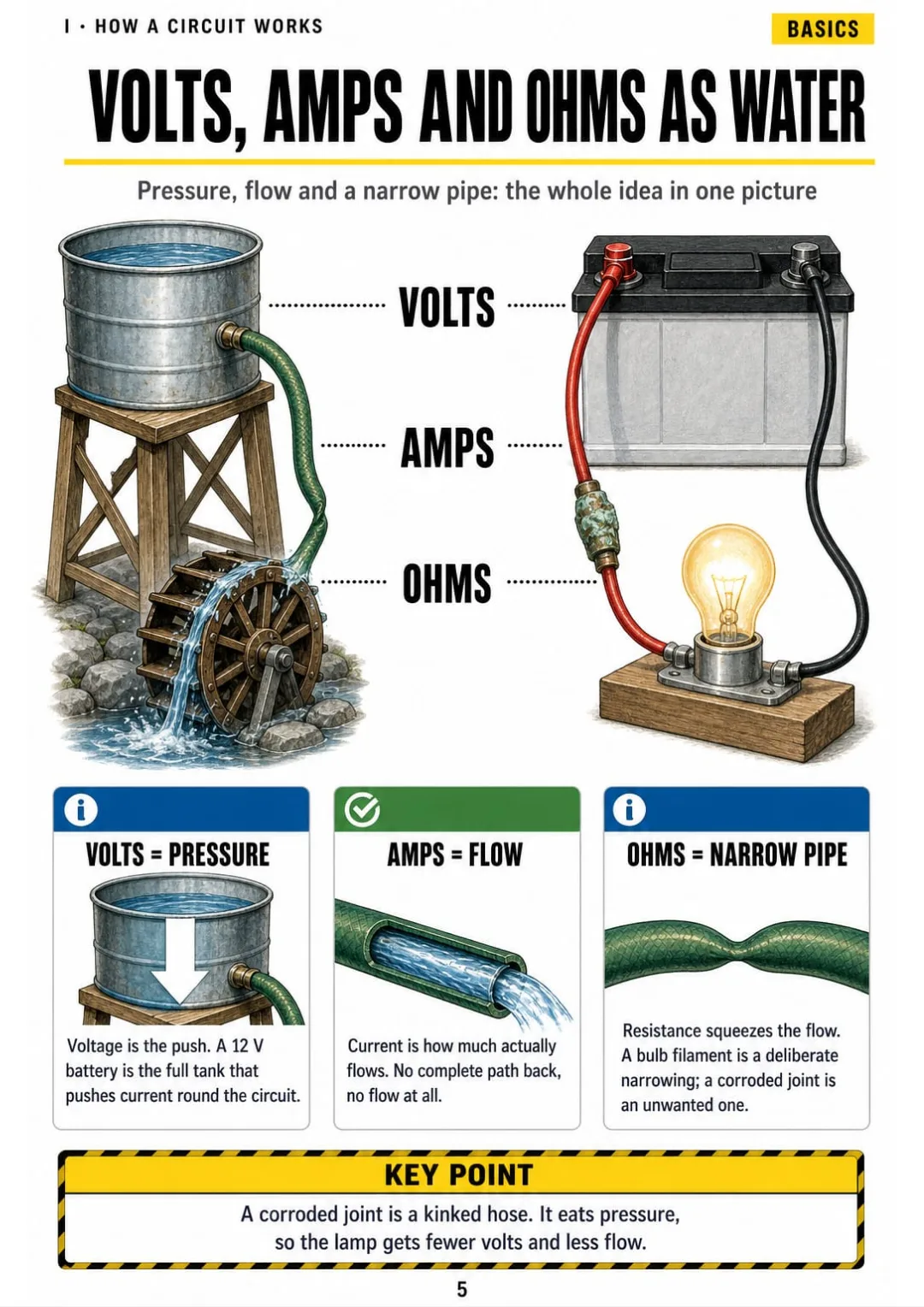
Volts, amps and ohms as water in a pipe, the five blocks of every circuit, open and short circuits, the body as half the wiring, positive and negative earth, and safety first.
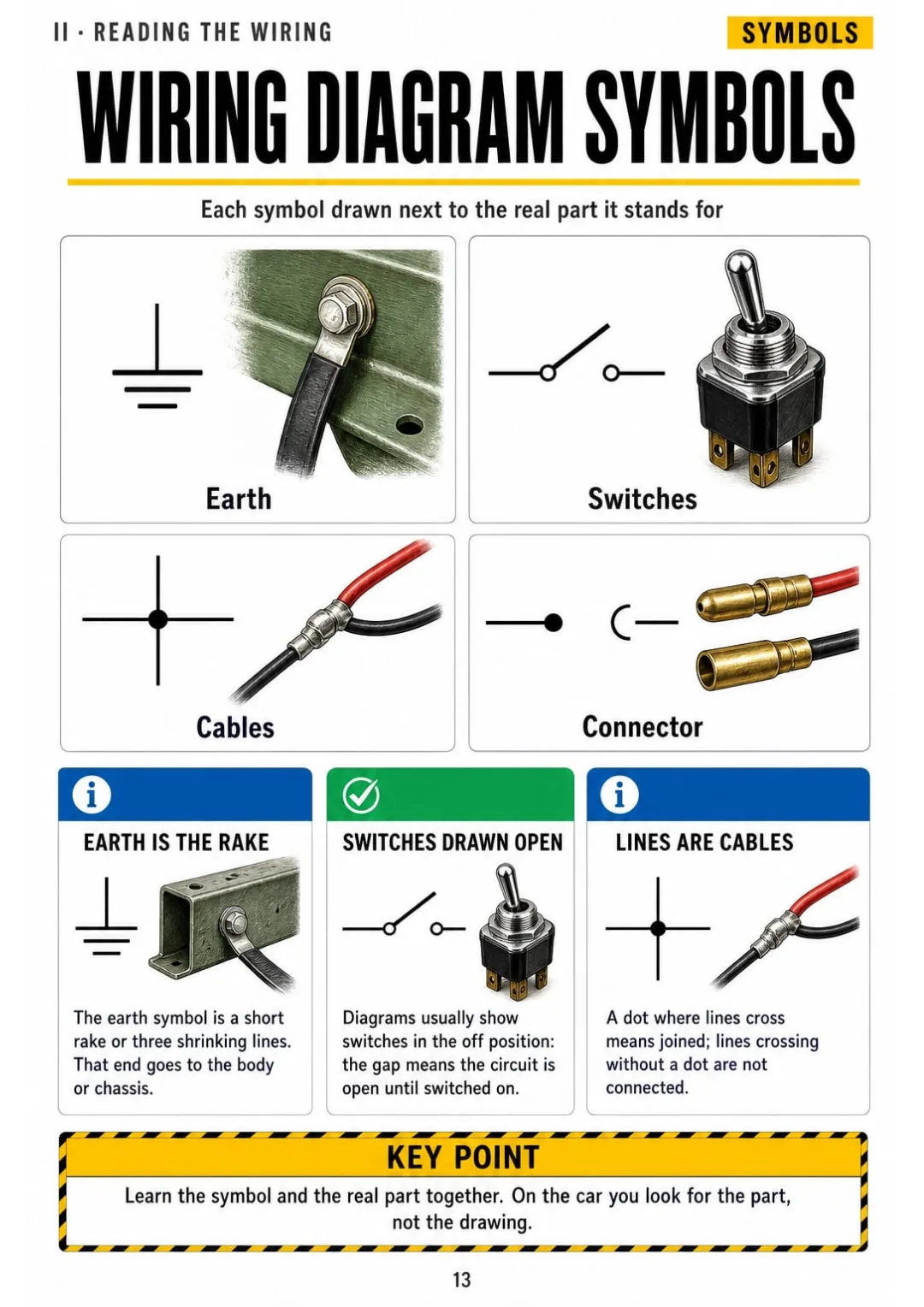
Diagram symbols, the British colour code, headlamp and indicator colours, cable sizes, connectors, the old two-fuse box and what a relay really does.
Your meter stops being a mystery: its three settings, test lamp or meter, a four-step fault-finding routine you follow the same way each time, voltage drop, continuity, the fused jumper lead and a worked example.
You know whether it's the battery, the dynamo or the control box: battery state at a glance, load testing, how a dynamo works, the control box, the charge light, charging voltage, the fan belt, the ammeter and the parasitic draw test.
The starter circuit in two halves, click but no crank, voltage drop on the heavy cables, inertia and pre-engaged starters, and the earth strap.
Coil, points and condenser, the points gap, dwell angle, testing the coil, HT leads, cap and rotor, the no-spark routine, strobe timing and electronic ignition.
Headlamps, dim lights, the relay upgrade, indicators and flasher unit, brake lights, the wiper self-park, the horn, the gauges and the lights the law still asks for.
Dynamo to alternator, positive to negative earth, a battery isolator switch, extra fuses and replacing the wiring loom.
A symptom-to-circuit finder, the most frequent electrical mistakes, readings worth remembering, a before-the-drive checklist and your garage toolkit.
At the end of the book: A symptom-to-circuit quick finder, readings worth remembering and a before-the-drive electrical checklist.
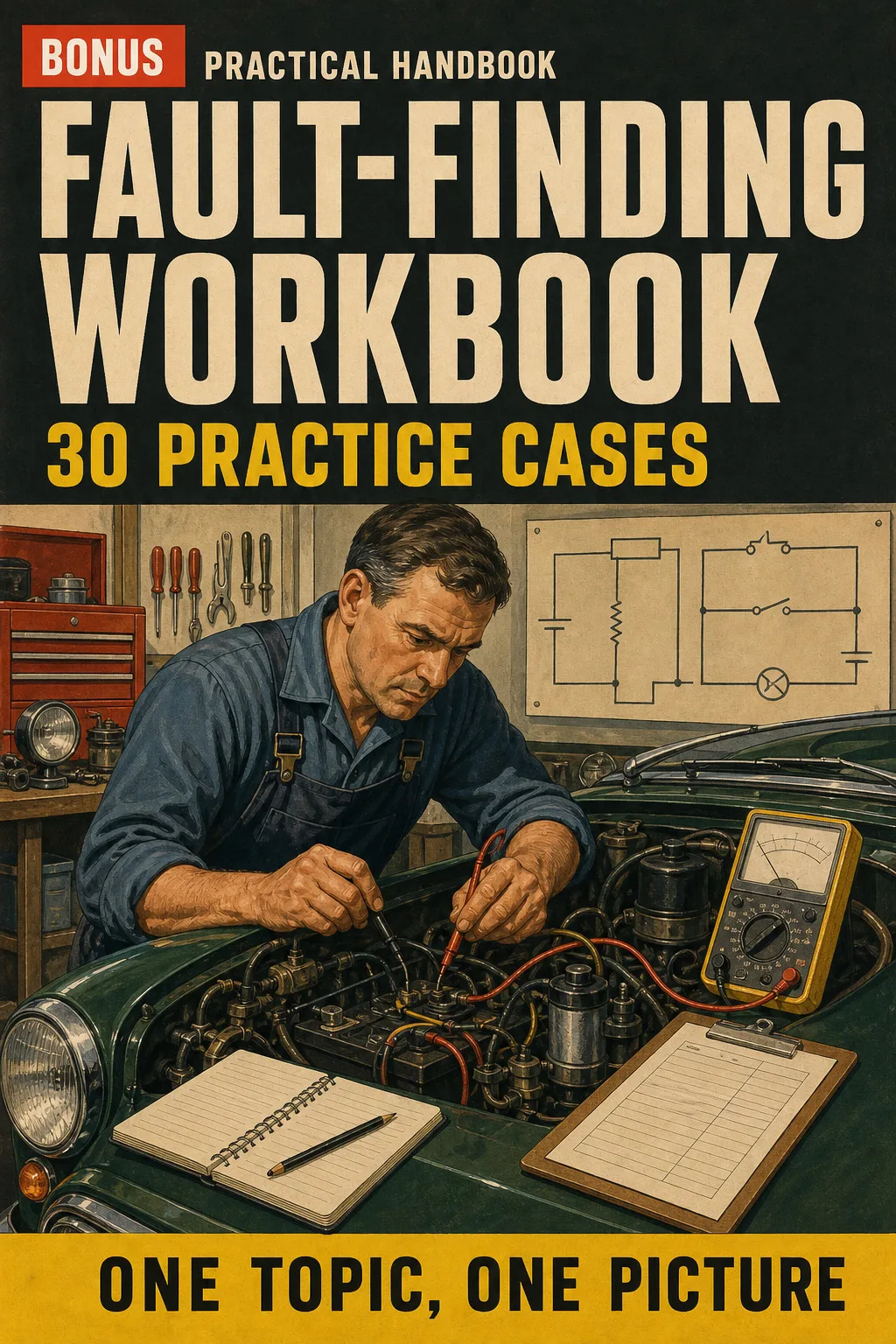
Practise the routine on 30 real symptoms (dim headlamps, charge light stays on, flat battery after a week) and check your reasoning against the worked answers before you pick up the meter.

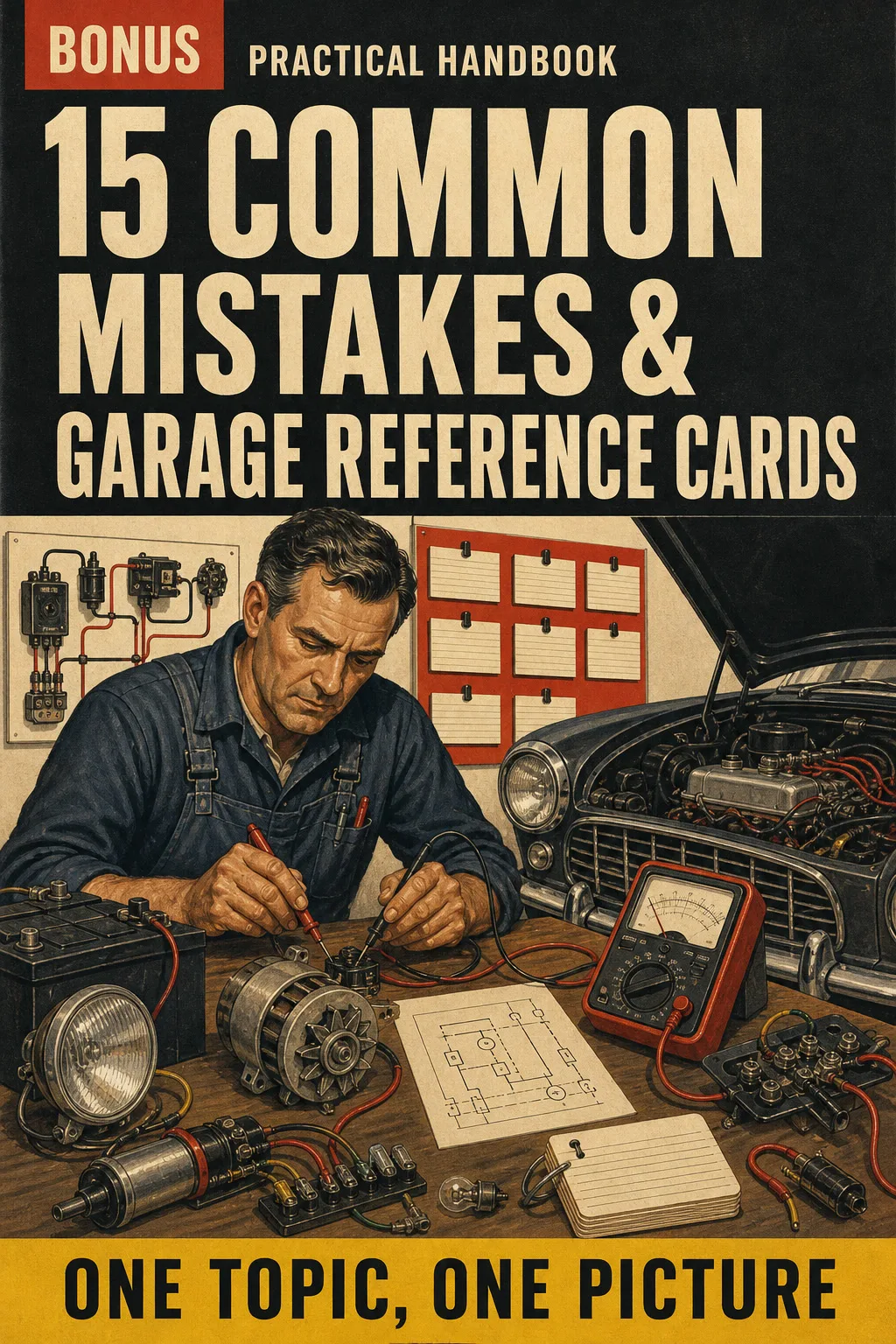
The mistakes that blow fuses, cook wiring or kill a battery, drawn before and after, plus printable cards with symbols, wire colours and test readings to keep at a glance in the garage.
📄 This is a digital PDF book sent to your email: nothing is printed or shipped.
PDF by email: We email you Classic Car Electrics Illustrated as a PDF, together with the two free books. It's a single payment: no installments, no extra charges.
Every circuit on your car drawn the same way, so the wiring diagram stops looking like spaghetti and starts reading in one order.
A flat battery, dim headlamps or a charge light that stays on: one routine, always in the same order, with the meter readings to expect.
Every circuit drawn before the new loom goes in, plus the upgrades: alternator, electronic ignition, headlamp relay and isolator switch.
📄 This is a digital PDF book sent to your email: nothing is printed or shipped.
Try Classic Car Electrics Illustrated for 30 days, bonus books included.
We refund everything if the file won't open, if the book isn't what you see here, if you were charged twice or if the email doesn't arrive. Just email us.
You pay once. No subscriptions.
Yes, if it's a British classic from roughly the 1950s to the 1980s. The book is written for cars like yours: positive earth, dynamo and control box, points ignition and the old two-fuse box, with a page on converting to negative earth if you choose to. Your model's own diagram and figures stay in its workshop manual.
The lighting pages follow the Road Vehicles Lighting Regulations 1989. The wiring uses the traditional British cable colour code found on classic cars. Charging, starting and ignition follow standard auto-electrical practice. Always check fuse ratings and fitting instructions against your manufacturer's data.
No. It's an independent illustrated book, not affiliated with or endorsed by any government body, standards body or manufacturer.
No, it works alongside it. Your workshop manual gives your model's wiring diagram and figures, and assumes you can read them. This book shows you how: every symbol and colour drawn, and how to test each circuit with a meter. If in doubt, ask a qualified auto electrician.
No. The 30 cases in the workbook are written for this book: typical symptoms with worked answers, not copied from any manual.
The book and the 2 bonus books arrive as PDFs by email, at the address you enter at checkout. It's a one-off payment, with no subscription.
Some of it, yes: scattered across threads and videos that often disagree. Here every circuit is drawn the same way, with one fault-finding routine and the readings to expect, in a PDF you can print and keep in the garage.
Yes. Print it at home or at a print shop and keep it in the garage.
You have 30 days. We refund everything if the file won't open, if the book isn't what you see on this page, if you were charged twice or if the email doesn't arrive: just email us.
No more rereading the wiring diagram and getting nowhere.
You disconnect the battery and test with a fused jumper lead, as the page shows, instead of hoping nothing burns.
You walk into the garage knowing where everything is.
Drawings make studying faster.
The book is right below.
One-time payment: US$ 27 · Guarantee: 30 days · PDF by email
YES, I WANT CLASSIC CAR ELECTRICS ILLUSTRATED FOR US$ 27📄 This is a digital PDF book sent to your email: nothing is printed or shipped.